
Space explainer
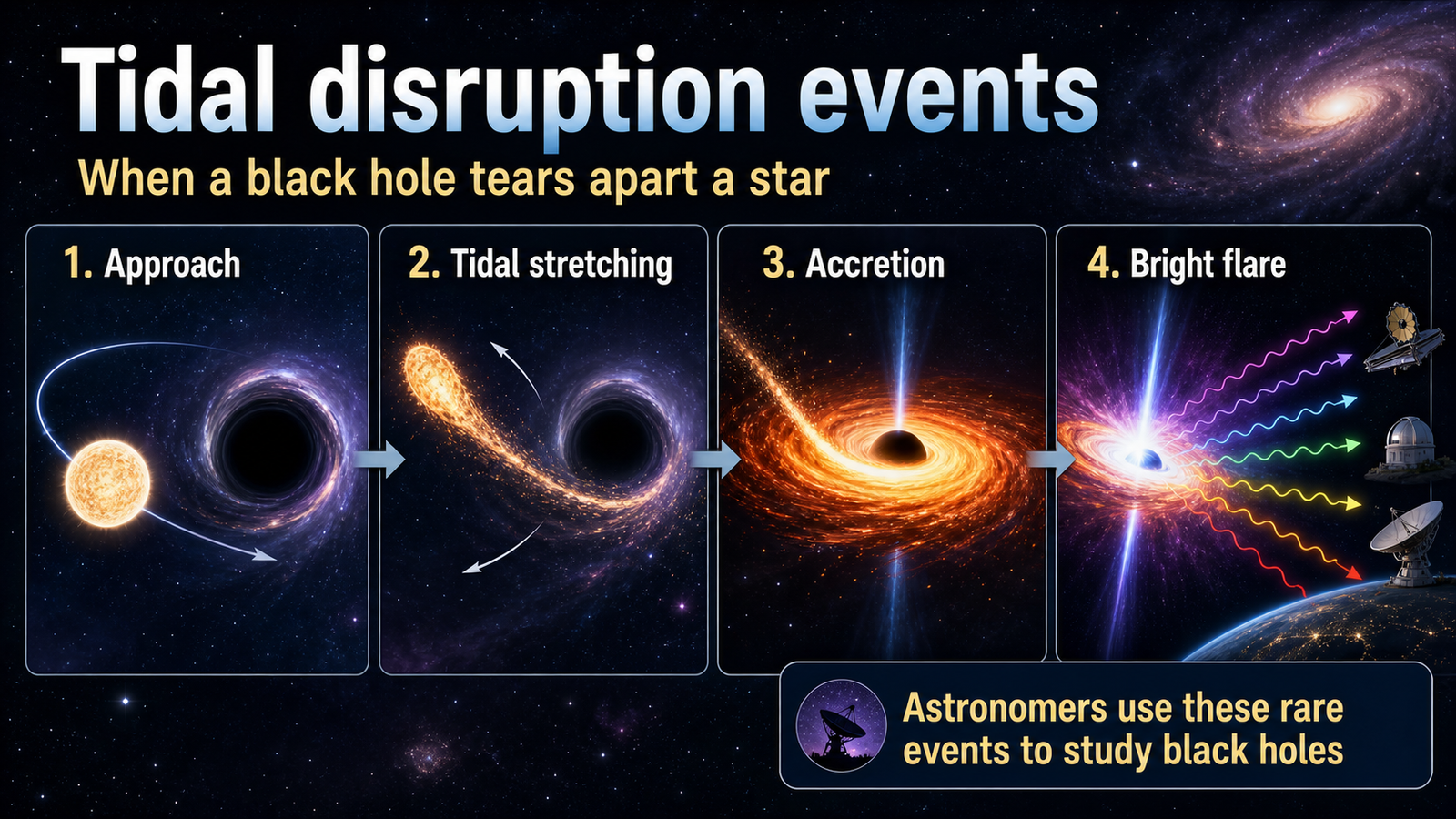
Tidal disruption events: when a black hole tears apart a star
A simple guide to one of the universe’s brightest black-hole events
In short: A tidal disruption event, or TDE, occurs when a star passes too close to a black hole and is pulled apart by extreme gravity.
A black hole can be difficult to detect when it is not actively consuming matter. A tidal disruption event gives astronomers a rare chance to observe one. The powerful gravity near the black hole stretches, disrupts and heats stellar material, producing a bright flare that telescopes can study.
How a tidal disruption event happens
1. A star approaches
A star moves dangerously close to a black hole.
A star moves dangerously close to a black hole.
2. Tidal stretching begins
The side nearest the black hole feels stronger gravity than the far side.
The side nearest the black hole feels stronger gravity than the far side.
3. The star is disrupted
The star is stretched into streams of hot gas and debris.
The star is stretched into streams of hot gas and debris.
4. A bright flare appears
Some debris falls inward, heats up and releases radiation.
Some debris falls inward, heats up and releases radiation.
Why astronomers study TDEs
- They can reveal otherwise quiet black holes.
- They help researchers study how matter behaves in extreme gravity.
- They can be observed at several wavelengths, including optical, ultraviolet, X-ray and radio light.
- Some TDEs can produce powerful jets of material.
- They improve understanding of stars and black holes in galaxy centres.
Examples of tidal disruption events
ASASSN-14li: A well-studied TDE discovered in 2014.
ASASSN-19bt: Observed early by NASA’s TESS mission.
Swift J1644+57: A famous event associated with a powerful jet.
50-point brief summary
- TDE means tidal disruption event.
- It involves a star and a black hole.
- The star passes very close to the black hole.
- Gravity is stronger on the near side of the star.
- This difference creates tidal forces.
- Tidal forces stretch the star.
- The star can be torn apart.
- The debris becomes very hot.
- Some debris can orbit the black hole.
- Some debris can fall toward the black hole.
- This process is called accretion.
- Accretion can create intense radiation.
- The event may appear as a bright flare.
- A flare can be detected by telescopes.
- Different telescopes see different wavelengths.
- Visible light can reveal a TDE.
- Ultraviolet light can reveal a TDE.
- X-rays can reveal a TDE.
- Radio observations can also help.
- TDEs are rare astronomical events.
- They can reveal hidden black holes.
- Some black holes are usually quiet.
- A TDE can make a quiet black hole visible.
- Not every disrupted star creates the same signal.
- Black-hole mass affects the event.
- Star mass affects the event.
- The orbit of the star also matters.
- Some debris escapes into space.
- Some debris remains gravitationally bound.
- Some events form bright accretion disks.
- Some events create high-speed jets.
- Swift J1644+57 was a jetted event.
- ASASSN-14li was widely studied.
- ASASSN-19bt was observed by TESS.
- TDEs help test accretion physics.
- They help study strong gravity.
- They help study galaxy centres.
- They help study stellar dynamics.
- They are not explosions caused by ordinary stars.
- They are caused by extreme gravity.
- The process can last for months or longer.
- The brightness usually changes over time.
- Scientists compare many observations.
- Computer models help explain the data.
- New sky surveys find more TDE candidates.
- Early detection improves scientific study.
- NASA missions have observed TDEs.
- TDEs are natural cosmic laboratories.
- They show how black holes affect nearby matter.
- They help explain the extreme universe.
Sources
Disclaimer: This page is an educational astronomy explainer. Scientific understanding changes as new observations and research become available.